
AC Repair vs. Replace: How Cincinnati Homeowners Should Decide
Your air conditioner quits during a 90-degree stretch, and a technician hands you a $1,400 quote. Most advice online tells you to multiply the repair cost by the system’s age. That shortcut was written before 2025, and it now skips the three things that move the most money.
Federal tax credits for HVAC equipment died on December 31, 2025. The refrigerant in new systems changed. On July 27, 2026, the EPA reopened a door that everyone thought had closed. Here is how a Cincinnati homeowner should actually run the numbers this summer.
The Fast Answer: When Repair Wins and When Replacement Wins
Repair your air conditioner when three conditions hold at once. The system is under 10 years old, the failed part is electrical or mechanical rather than sealed-system, and the quote lands under about $800.
Replace it when any one of these is true:
- The compressor has failed and the system is past 10 years
- The evaporator coil leaks on an R-22 system
- You have paid for two or more repairs in the past three cooling seasons
- The furnace or air handler is also near end of life
- Total repair cost exceeds one third of a full replacement quote
Everything else falls into a middle zone. The rest of this guide is about pricing that middle zone honestly.
Why the $5,000 Rule Breaks Down in 2026
The $5,000 rule tells you to multiply repair cost by system age. A $500 repair on a 12-year-old unit scores 6,000, so you replace. A $300 repair on a 7-year-old unit scores 2,100, so you fix it.
The arithmetic is fine. The inputs are stale.
The rule assumes every dollar of repair buys the same thing. In 2026, a $900 refrigerant repair on an R-22 system buys you a leak that will come back. A $900 blower motor on the same system buys you five more years. The rule cannot tell those apart because it never asks what broke or what refrigerant the system holds.
The rule also assumed a federal tax credit sat on the replacement side. That credit is gone. Replacement now costs more out of pocket than it did in December 2025, which pushes borderline cases back toward repair.
Use the rule as a rough sort. Then correct it with the two factors below.
What Refrigerant Your System Uses Changes the Math
Find the nameplate on your outdoor unit. It lists the refrigerant. This single line item decides whether a sealed-system repair is worth attempting.
R-22 Systems, Installed Before Roughly 2011
The EPA ended R-22 production and import in 2020. Only reclaimed and stockpiled supply remains, and it prices accordingly. Reclaimed R-22 runs roughly $100 to $200 per pound, and a residential system holds 6 to 12 pounds. A full recharge can reach $2,400 and buys you no new equipment.
If your R-22 system leaks, replace it. If your R-22 system needs a capacitor, fix it and start budgeting.
R-410A Systems, Roughly 2011 Through 2025
Manufacturers stopped building R-410A residential systems on January 1, 2025. Servicing them stays legal, and refrigerant remains available. Material prices sit near $12 per pound, so a routine 2 to 6 pound top-off usually totals $150 to $700 with labor.
The pressure here is slow and directional. Under the AIM Act, the EPA caps total production of these refrigerants at 60 percent of baseline through 2028, then drops the cap to 30 percent for 2029 through 2033. Each step tightens supply for everyone still servicing an R-410A system.
That timeline matters for a 14-year-old unit that leaks. It matters much less for an 8-year-old unit that needs a contactor.
R-454B and R-32 Systems, 2025 and Newer
New systems ship with these lower-GWP refrigerants. They are classified A2L, meaning mildly flammable, and equipment standards handle that with charge limits and leak detection. Material costs more, roughly $25 per pound for R-454B, though labor still dominates small jobs.
One rule catches people off guard. R-454B is not a drop-in for R-410A. You cannot top off an old system with new refrigerant, and you cannot bolt a new outdoor unit onto an old indoor coil.
The EPA Rule That Changed on July 27, 2026
The original phase-out banned installing leftover R-410A equipment after January 1, 2026. The EPA reversed that. A final rule published in May 2026 removed the installation deadline entirely, and it took effect on July 27, 2026.
Contractors can now install pre-2025 R-410A inventory until that inventory runs out. If you are shopping replacement quotes in Cincinnati this month, you may be offered one.
That is a real option, not a scam, but weigh it carefully:
- In favor: lower equipment price, mature platform, parts stocked at every local supply house, technicians who have serviced it for 15 years
- Against: you are buying a system that runs on a refrigerant scheduled to fall to 15 percent of baseline production by 2036, which means service costs climb across the system’s life
Ask any contractor quoting a bargain condenser one question. Is this unit R-410A or A2L? Get the answer in writing on the proposal.
Every Federal HVAC Tax Credit Expired on December 31, 2025
The One Big Beautiful Bill Act, signed July 4, 2025, terminated Section 25C and Section 25D for property placed in service after December 31, 2025. Section 25C had covered 30 percent of qualifying costs, up to $600 for a central air conditioner and $2,000 for a heat pump. Section 25D covered geothermal.
Neither applies to a 2026 installation. The controlling date is when the system was placed in service, not when you bought it. The IRS guidance on the OBBB provisions spells this out.
Plenty of Cincinnati HVAC pages still advertise these credits. Some also promote Duke Energy Smart $aver rebates to Ohio customers. Duke’s home energy improvement rebates serve its Carolinas, Florida, Indiana, and Kentucky territories. Ohio Duke customers have no general residential HVAC rebate, because Ohio House Bill 6 ended utility efficiency mandates statewide by the close of 2020.
What Cincinnati Homeowners Can Still Use
Four things remain worth checking before you sign anything:
- ECO-Link, run by the Ohio Treasurer, cuts up to 3 percent off the rate on a home improvement loan up to $50,000. On a $12,000 project that is real money over five years.
- The City of Cincinnati residential rebate, administered by the Greater Cincinnati Energy Alliance, is reported at 50 percent of costs up to $1,500 with a $1,000 project minimum. Confirm current terms with GCEA directly before you build it into your budget.
- HEAR and HOMES, Ohio’s $249 million in federal rebate funding, have not launched. Watch the Ohio Department of Development for announcements, and treat any contractor quoting you a HEAR amount today as guessing.
- Contractor financing, which for most Cincinnati homeowners now carries more weight than any incentive. Haven publishes its HVAC financing options for exactly this reason.
Repair or Replace, Sorted by What Actually Failed
The part that broke tells you more than the calendar does.
Capacitor, contactor, or fan motor. Repair at almost any age. These are wear items, they cost a few hundred dollars installed, and replacing one says nothing about the rest of the system.
Thermostat or control board. Repair. A failure here rarely signals sealed-system trouble.
Condenser fan motor or blower motor. Repair under 12 years. Past 12, price it against a full quote before committing.
Evaporator coil. This is the hinge. A leaking coil on an R-22 system means replacement. On an R-410A system, a coil replacement can make sense if the compressor tests clean and the system is under 12 years old.
Compressor. Past 10 years, replace the system. A compressor swap consumes a large share of a new system’s price, and it leaves you with an old coil, an old line set, and no meaningful warranty on the rest.
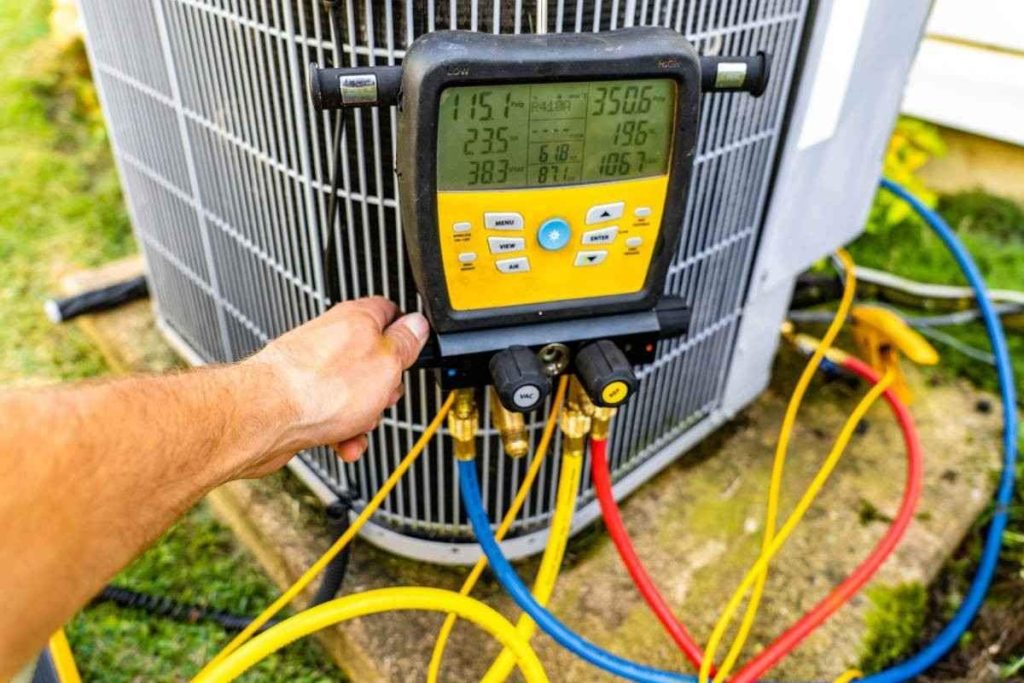
Ask your technician to test compressor amp draw and superheat, then to write down the readings. Those numbers separate a real diagnosis from a guess.
What AC Replacement Costs Around Cincinnati in 2026
A straightforward condenser and coil swap in an existing-ductwork home generally lands between $5,000 and $9,500. National benchmarks for a standard 3-ton mid-efficiency system sit in the $6,000 to $9,500 band, and Midwest labor rates track close to average.
Pairing a new AC with a new furnace pushes the total well past $10,000. Industry analysts put the A2L equipment premium at roughly 8 to 10 percent over the outgoing generation, and that premium is already inside today’s prices.
Your quote should itemize these separately:
- Outdoor condensing unit, with model number and SEER2 rating
- Indoor evaporator coil, matched to the condenser
- Line set, either reused or replaced, with the reason stated
- Electrical disconnect, whip, and pad
- Mechanical permit and inspection
- Old equipment removal and refrigerant recovery
If a proposal shows one number and no model numbers, you cannot compare it to anything. Ask for the breakdown.
Cincinnati Details That Change Your Answer
Ohio and Kentucky Have Different Legal Minimums
The Department of Energy splits the country into efficiency regions. Ohio sits in the North region, where a new split-system air conditioner must hit at least 13.4 SEER2. Northern Kentucky sits in the Southeast region, where the minimum is 14.3 SEER2. AHRI publishes the regional standards in full.
Cincinnati contractors work both sides of the river and stock both. A homeowner in Anderson Township and a homeowner in Fort Thomas can be quoted different equipment for the same house.
Humidity Matters More Than Peak Heat Here
Cincinnati’s normal July high is 86 degrees, with a normal low of 66, according to NWS climate normals for CVG. Those are not extreme numbers. The Ohio River Valley’s moisture load is what wears equipment down.
An oversized system cools the air fast, shuts off, and never runs long enough to pull moisture out. The house feels clammy at 72 degrees. Insist on a Manual J load calculation rather than a same-size swap, and ask how the proposed system handles latent load.
Check the Furnace Before You Decide
Your evaporator coil sits on top of your furnace. If the furnace is also 15 years old, replacing only the AC means opening the same cabinet again in two years. Price both. Haven’s furnace replacement page covers what that side of the job involves.
How to Pressure-Test the Quote in Front of You
Four checks take about ten minutes and protect a five-figure decision.
- Verify the license. Ohio licenses HVAC contractors through the Ohio Construction Industry Licensing Board. Ask for the number and search it at elicense.ohio.gov.
- Confirm the permit. Ask which building department the mechanical permit goes to and whose license it gets filed under. Decline any offer to skip it.
- Demand a matched system. The indoor coil and outdoor unit must be an AHRI-certified match. Mismatched equipment underperforms its rating and can void the warranty.
- Get two diagnoses, not two prices. A second opinion is only useful if the second technician also tests and documents. Compare findings, then compare dollars.
Frequently Asked Questions
Can I Replace Just the Outdoor Unit?
Almost never in 2026. New outdoor units use R-454B or R-32, which are not compatible with an R-410A indoor coil. Manufacturers require matched systems, and a mismatch costs you both efficiency and warranty coverage.
Is My R-410A System Now Illegal?
No. You can run, service, and recharge it for its full remaining life. Nothing about the phase-down forces you to replace working equipment.
Should I Wait for Ohio’s HEAR Rebates?
Only if your income qualifies and your system still runs. HEAR covers up to $8,000 for heat pumps for households under 150 percent of area median income. Ohio has not launched the program and has not set a date. Do not sit through a Cincinnati August on a promise.
How Long Should a Cincinnati AC Last?
Plan on 12 to 17 years with annual maintenance. Systems that never got a tune-up fail earlier, usually at the coil or the compressor.
Get a Written Diagnosis Before You Get a Sales Pitch
The repair-or-replace decision is not a judgment call. It is a set of measurements: refrigerant type, compressor readings, coil condition, system age, and a real replacement quote to compare against.
Haven’s Cincinnati technicians test the system, explain the findings in plain language, and give you the price before any work starts. Book same-day AC repair in Cincinnati, or ask for a side-by-side replacement quote through AC installation. If the answer is repair, we will tell you that.
Call us today or schedule service online.
Opening Hours
- Monday
- Tuesday
- Wednesday
- Thursday
- Friday
- Sat - Sun
Check Out Some of Our Projects
Explore more of our projects in our portfolio.
See What Our Customers Say About Haven


Today I had problem in my bathroom,.They looked very well and explained to me very clear. I love that he talk with respect and you can see he have knowledge. They will coming back to changed my shower handle.


Al and Tony were very efficent and informative about what had caused the leak. They came in and quickly determined what the issue was and how to fix it. After they had fixed the leak they cleaned everything up! They were wonderful and I would recommend them 100%.

The technician, Bobby and Jeff were polite and considerate. Came in surveyed the trouble area, made an assessment, repaired the supply line to the toilet and replaced the toilet valve. No leaks detected.

Jonny was quick, efficient and kind. He came to my home within an hour and fixed my issue within 15 min on Christmas Eve for an affordable price.


They are professional, knowledgeable, and efficient. They fixed my 🚿 shower pipe that was disconnected from the main unit in less than hour. I'll definitely use them for many more plumbing issues. The price was super reasonable and the plumbers were super friendly. 👍👍👍


Had a water leak I thought was from upstairs bath tub vs roof leak. Dan did not rush, was at my home for 2 hours trying to find leak but no leaking pipes found. Also had toilet tank seal and flushing device replaced.


We’ve used them several times and each time they were able to come the same day, had profession and friendly employees, and were a good value!


Piotr was able to identify the issue with our sewage system and explain what needed to be done. The quoting process was easy, we were able to accept and fund online. Piotr and his friendly crew took care of all the permits and inspections needed. As the work was being done, he explained what they needed to do and why. We now have a properly working, updated sewage system which was done quickly, professionally and cleanly.


Prompt reply, Quick to get service for new garbage disposal installation. , Polite and knowledgeable service man with the product I needed on hand. And he left his workplace clean. Highly recommended!!

Tony was knowledgeable, professional, friendly and extremely trustworthy, thoroughly explained the issue, the root cause of the issue and then offered us our options and his opinion on what we should do based on his experiences in the business for over 30 years. We completely felt comfortable and very appreciative of his opinion and we knew that it would be done correctly. While he was there to take care of the issue we scheduled him for, he noticed a very serious issue with how the gas line was installed by another contractor. He provided us with a written estimate of what needed to be corrected and we are scheduling it to be done as well!


Plumbers were great, did a bang-up job, answered all my questions, and were truly pleasant gentlemen.

The initial call was to unclog the drain located in the laundry room, however, the cable would not clear 75' out. However, Mike did everything he could and stayed even though we were having a thunderstorm and the power went out. So, he installed a new sump pump in the sump crock in basement. Mike is very professional, helpful, and friendly. He explained everything that needed to be done and answered all my questions.


Kyle and Jack provided truly outstanding service installing the water line for my new LG refrigerator's ice maker and water dispenser. The job presented some complexity, but they professionally "figured it out" and got the line perfectly installed. I was particularly impressed with how neat and meticulous they were throughout the process. The final result looks great, and everything is working nicely. Highly recommend these two for any tricky installation!

Great work by a super professional at a fair price. Have used them multiple times and am never disappointed. Highly recommend.

They showed up when they said they were going to show up did the work as expected and no surprises on the bill. Great competent employee.

Had a water line extended and an outdoor spigot attached. The extension was literally 5 feet. Job took only an hour. Paid 572 dollars with a senior discount. I thought it was a little much, but the work was well done. Plumber was great.

Overly expensive for the work done. This was a simple repair. The work was done properly. The bill was exorbitant.

Al looked at sump pump and found it to be OK but other issues were discussed. The basement set tub will need replacing and a sump pump with battery backup was recommended. He is very knowledgeable and guided us through the process for a later date.


Brandon arrived on time and solved my problems with my toilets quickly. I am very pleased with the service.

Awesome job. Have used them for 4 years possibly more. Professional on time and very appreciative of their services.

Always honest, with good customer service. After trying out other companies, I went back to them.


Bobby was great he took really good care of me and kept me updated all along the way. He was efficient, clean, and respectful. Took care of all of the several plumbing issues I was having.

My technician today was fast and pretty sure that the problem was the flapper in the toilet needing to be changed lets see if this is it, i believe it will help as well thank you

The service tech arrived promptly and went right to work. Peter was his name and he did an awesome job, repaired everything I needed done plus an extra request. Would recommend this company and Peter to anyone needing plumbing services.


The experience I had with this company was not. My toilets kept flushing and the plumbing technician said, “he knew exactly what the problem is changed out all the filters in my toilet tanks but this wasn’t the problem.” He said, “the work has a warranty for a year.” The problem was not solved therefore I contacted the office again to explained the problem wasn’t solved. I told the same person Blake plumbing technician will be out to Resolve the issue and exactly what problem is but failed to correct it the first time. Now they’re telling me I would need to pay the same price twice in order to correct the problem with the Continuously Flushing. I contacted the office and Claire tells me she would need to inform the owner regarding how much I should pay. She did contacted me back to resolve the toilet tank installation but tells me that flushing mechanism needs to be changed out. The company doesn’t care about their customers just money.

Easily the best experience I’ve had with a plumbing company. Johnny show up early (they let us know who was coming and when), fixed the issue and left everything in better condition than when they showed up. Johnny was very professional and communicated very well! Reasonable pricing as well!
